

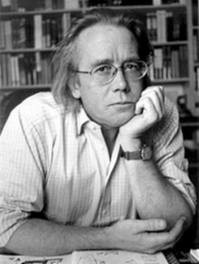
Gary Fisketjon, "whose discovery and cultivation of an army of literary talents, including Jay McInerney, Bret Easton Ellis, Donna Tartt, and Cormac McCarthy, earned him a reputation as one of the greatest literary editors of his generation," died November 7, the New York Times reported. He was 72.
 |
|
| Gary Fisketjon (photo: Jane Wexler) |
|
Fisketjon was a young editor at Random House in the early 1980s when he emerged as a champion of young, urban writers like McInerney, whose debut novel Bright Lights, Big City was successfully published through Fisketjon's imprint, Vintage Contemporaries, allowing him to take risks on new authors and to resurrect the careers of respected writers like Raymond Carver and Thomas McGuane.
Fisketjon "developed a reputation for methodical editing and close personal relationships with his writers. Armed with a green pen, he would go slowly, reading just five pages an hour, covering each with a spider web of notes, suggestions and cuts," the Times noted.
"Editing's just a more relentless and specific form of reading in which you read a book more closely than any sane person would ever think of doing," he wrote in the Washington Post in 2023.
McInerney said, "Gary always respected the basic premise, the basic architecture. He didn't try to make a book different, but just make it the best version of itself."
A "born literary showman," Fisketjon was adept at marketing, the Times wrote, adding that "to celebrate a new book from another of his authors, Richard Ford, he rented out the Palladium, one of the era's hottest night clubs."
From the mid-1980s on, Fisketjon attended the Frankfurt Book Fair. Morgan Entrekin, CEO of Grove/Atlantic and a longtime friend, said, "Gary's sort of imprimatur and passion for a book would carry over, and there would be 10 or 15 publishers from around the world who would line up to to want to acquire the rights."
In 1990, after a four-year stint at the Atlantic Monthly Press, Fisketjon became an editor-at-large at Knopf, where he expanded his range to include established writers like McCarthy as well as international authors like Martin Amis and Haruki Murakami. He also continued to seek out promising new talent.
"I don't know how many new writers' work I look at over the course of a year but hundreds and hundreds and hundreds," he told Chapter 16, a literary website, in 2013. "And ninety-nine times out of a hundred you're going to say, 'Thanks, not for me.' When you can actually say, 'Yes, this is for me,' it's quite a wonderful feeling."
In the 1970s, he had enrolled at the University of San Francisco before transferring for his sophomore year to Williams College in Williamstown, Mass., where he befriended McInerney. Fisketjon graduated with a degree in philosophy and history in 1975. The Times noted that he eventually "enrolled in the Radcliffe Publishing Course, a boot camp for editors in Boston (renamed, it is now at Columbia University's Graduate School of Journalism in New York). He met Mr. Entrekin on his first day; students were seated in alphabetical order."
After a year working at William Morrow, Fisketjon was hired as an assistant to Jason Epstein, the editor in chief of Random House, in 1978. He became an editor in 1980, and the first book he acquired was Gilbert Sorrentino's Aberration of Starlight (1980), a finalist for the Pen/Faulkner Award the next year.
His career timing was perfect. "In a way, there was a missing generation in publishing," he told the Nashville Scene. "Companies were looking around, saying, 'We're all old; we should get some young people.' "
"While the various stages in the publication process are all interesting, my favorite is the editing," he told Vice in 2007, "getting into the DNA of the book by reading it so closely, figuring out where it works best and where it might be improved, but mostly to understand what makes it so good."
Knopf fired Fisketjon in 2019, citing a "breach of company policy." The publisher did not reveal details. The Times wrote that he "got sober, and after several years as a freelance editor, joined County Highway, a publication focused on rural America, and its books imprint, Panamerica, as its literary editor.
David Samuels, the editor of County Highway, said he had created Panamerica with an editor like Fisketjon in mind: "He was the most important editor of American fiction in the last 50 years. The idea that Gary was available to us was a no-brainer."